
Table of Contents
- Quick Answers at a Glance
- Toronto to New York Flight Time
- Driving: Distance, Hours & Route
- Distance Between the Cities
- By Train
- By Bus
- Cheapest Way to Travel
- Airports on the Route
- Best Time to Book & Fly
- Airlines on the Route
- Border Crossing & Documents
- Season-by-Season Guide
- In-Depth Mode Comparison
- Luggage & Packing Tips
- Airports into the City
- Making the Most of NYC
- Connecting Flights
- For Business Travellers
- How to Book Step by Step
- True Cost of Each Option
- Road-Trip Itinerary
- Kids, Pets & Accessibility
- Ten Ways to Save Money
- Common Mistakes to Avoid
- Complete FAQ
- Cheat Sheet Recap
Planning a trip between Toronto and New York? Whether you want the fastest flight, a scenic road trip, the cheapest way to cross the border, or a comfortable train ride, this complete guide covers everything you need to know in 2026. We break down flight times, driving hours, distances, ticket prices, border requirements, and insider booking tips so you can travel between Canada’s largest city and the Big Apple with confidence.
At Get Airline, we help thousands of Canadian and American travellers book smooth, affordable trips every year. This guide reflects real routes, real timings, and the questions travellers ask us most often. Let’s get started.
Want a human to plan your Toronto–New York trip for you?
Speak with a Get Airline agent for the best fares to Canada & the USA.
Quick Answers: Toronto to New York at a Glance
If you’re short on time, here are the essential facts about travelling between Toronto, Ontario and New York City. We explain each of these in detail further down the guide.
| Travel Detail | Answer |
|---|---|
| Flight time (non-stop) | Approximately 1 hour 30 minutes |
| Flight distance | About 570 km (355 miles) |
| Driving distance | About 790 km (490 miles) |
| Driving time | Roughly 8 to 9 hours (without long stops) |
| Train time (Amtrak Maple Leaf) | Around 12 to 13 hours |
| Bus time | Roughly 10 to 12 hours |
| Cheapest option | Bus or advance-purchase flight deals |
| Fastest option | Non-stop flight |
| Main Toronto airport | Toronto Pearson (YYZ) |
| Main New York airports | JFK, LaGuardia (LGA), Newark (EWR) |
Toronto to New York Flight Time
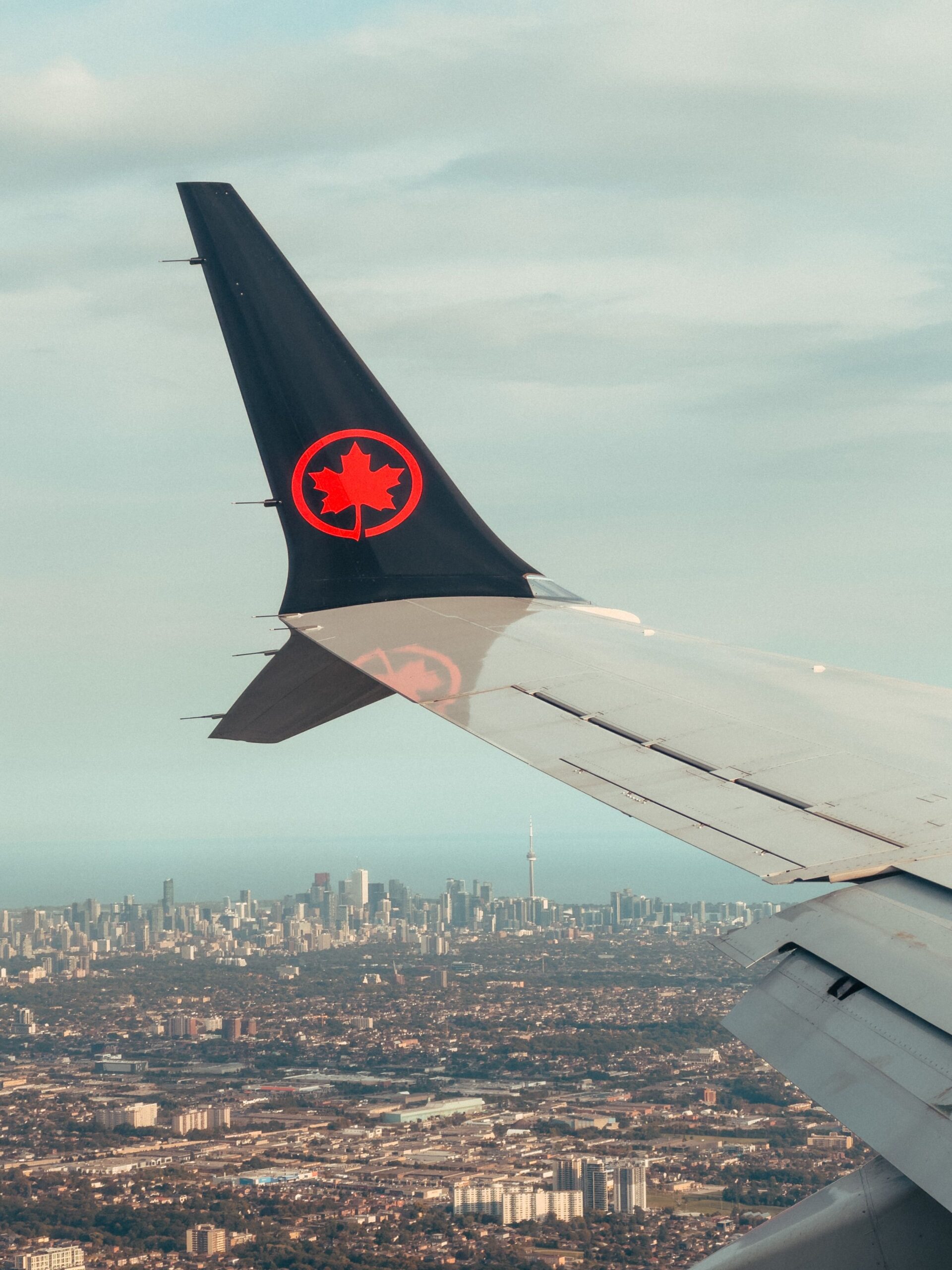
A non-stop flight from Toronto to New York takes approximately 1 hour and 30 minutes in the air. In practice, the total travel time is longer once you add check-in, security, boarding, taxiing, and possible delays. Most travellers should plan for roughly three hours from arriving at the airport to landing at their destination.
The exact flight time depends on which airports you use, wind conditions, and air-traffic routing. Here is a breakdown of typical non-stop flight durations between the main airports on this route:
| Route | Typical Non-Stop Flight Time |
|---|---|
| Toronto Pearson (YYZ) to New York JFK | 1 h 25 m – 1 h 35 m |
| Toronto Pearson (YYZ) to LaGuardia (LGA) | 1 h 20 m – 1 h 30 m |
| Toronto Pearson (YYZ) to Newark (EWR) | 1 h 25 m – 1 h 35 m |
| Toronto City (YTZ) to Newark (EWR) | 1 h 20 m – 1 h 30 m |
Westbound and eastbound flights can differ slightly because of prevailing winds, but on such a short hop the difference is usually only a few minutes. Because the flight is so short, the aircraft often reaches cruising altitude and begins its descent again in quick succession.
How many hours is the flight from Toronto to New York?
The flight itself is about one and a half hours. When people ask “how many hours from Toronto to New York by plane,” they usually mean gate-to-gate, which is close to the same figure plus taxi time. Realistically, budget around 90 minutes of flying and arrive at the airport at least two hours before a cross-border departure, since you’ll clear U.S. customs pre-clearance at Toronto Pearson.
New York to Toronto flight time
The return leg, New York to Toronto, takes about the same time: roughly 1 hour 30 minutes non-stop. On the northbound journey you clear Canadian customs after you land in Toronto rather than before departure, so the airport process feels a little different even though the air time is nearly identical.
Ready to book the fastest Toronto–New York flight?
Speak with a Get Airline agent for the best fares to Canada & the USA.
Driving from Toronto to New York: Distance, Hours & Route

Driving between Toronto and New York City is one of the most popular ways to make the trip, especially for travellers who want flexibility, plan to explore along the way, or are travelling with a family and lots of luggage. The driving distance from Toronto to New York is roughly 790 kilometres (about 490 miles), and it takes approximately 8 to 9 hours of driving time without long stops.
Of course, real-world trips are rarely non-stop. Once you add a border crossing, meal breaks, fuel stops, and possible traffic around New York City, many travellers find the door-to-door journey takes closer to 10 or 11 hours. Planning an overnight stop turns the drive into a comfortable two-day road trip.
Best route to drive from Toronto to New York
The most common driving route follows major highways through Ontario and New York State. A typical path looks like this:
- Toronto to the border: Take the QEW or Highway 403 toward the Niagara region, crossing into the United States at one of the Niagara Falls bridges (such as the Rainbow Bridge or the Queenston–Lewiston Bridge).
- Across New York State: Join Interstate 90 (the New York State Thruway) heading east toward Syracuse, then continue toward Albany.
- Albany to New York City: Take Interstate 87 (the Thruway) south, which brings you down toward the New York metropolitan area and into the city.
An alternative route crosses at Buffalo and can be slightly quicker depending on border wait times. Always check live border wait times before you leave, as delays at the crossing can add anywhere from a few minutes to over an hour.
| Driving Segment | Approx. Distance | Approx. Time |
|---|---|---|
| Toronto to Niagara border | 130 km (80 mi) | 1 h 30 m |
| Border to Albany area | 460 km (285 mi) | 4 h 30 m |
| Albany to New York City | 240 km (150 mi) | 2 h 45 m |
| Total | ~790 km (490 mi) | ~8–9 hours |
How many hours is the drive from Toronto to New York?
Pure driving time is about 8 to 9 hours. Realistically, plan for 10 to 11 hours door-to-door once you factor in the border crossing and breaks. If you’re driving with children or want to enjoy the scenery, splitting the journey with an overnight stay near Syracuse or Albany makes for a far more relaxed trip.
What you need to drive across the border
To drive from Toronto into the United States, every traveller needs valid travel documents. Canadian and American citizens should carry a valid passport (or an accepted alternative such as a NEXUS card or enhanced driver’s licence for land crossings). Travellers from other countries may need a visa or an approved ESTA. If you’re renting a car, confirm with the rental company that the vehicle is permitted to cross the border, and carry the vehicle’s insurance and registration documents.
Toronto to New York road trip stops worth making
One of the joys of driving instead of flying is the chance to break up the trip with memorable stops. Popular options along or near the route include Niagara Falls on the Canadian side before you cross, the Finger Lakes wine region in central New York, and the historic city of Albany. These make natural rest points and turn a simple transfer into a genuine road-trip experience.
Prefer to fly instead of a long drive? We can find you a great fare.
Speak with a Get Airline agent for the best fares to Canada & the USA.
Distance Between Toronto and New York
Understanding the distance helps you choose the right mode of travel. There are two different distances to consider: the straight-line flight distance and the road distance you’d actually drive.
| Type of Distance | Kilometres | Miles |
|---|---|---|
| Flight (straight-line) distance | ~570 km | ~355 mi |
| Driving (road) distance | ~790 km | ~490 mi |
The reason the driving distance is much longer than the flight distance is simple: aircraft travel in a nearly straight line, while roads must follow the terrain, skirt Lake Ontario, and route through the Niagara border crossing before heading east and south across New York State. This is why flying is dramatically faster even though the two cities feel relatively close on a map.
How far is Toronto from New York?
In a straight line, Toronto is about 570 km (355 miles) from New York City. By road it’s about 790 km (490 miles). For most travellers, that means a short 90-minute flight or a full-day drive.
Toronto to New York by Train

Taking the train between Toronto and New York is a scenic, relaxed alternative for travellers who aren’t in a hurry. Amtrak’s Maple Leaf service connects Toronto’s Union Station with New York’s Penn Station, running once daily in each direction. The journey takes approximately 12 to 13 hours, including the border-crossing inspection.
The train follows a beautiful route along the Niagara region, the shores of the Hudson River, and through upstate New York. Because it’s a long journey, most travellers pack snacks, download entertainment, and treat the ride itself as part of the experience. The border inspection happens on board at the crossing, so you’ll need your travel documents ready.
| Train Detail | Information |
|---|---|
| Service | Amtrak Maple Leaf |
| From / To | Toronto Union Station ↔ New York Penn Station |
| Duration | ~12–13 hours |
| Frequency | Once daily each direction |
| Best for | Scenery, comfort, no driving |
Toronto to New York by Bus
Intercity buses are typically the cheapest way to travel between Toronto and New York. Several carriers operate this route, with journey times ranging from about 10 to 12 hours depending on the schedule and border wait. Overnight buses are popular because they let you sleep through much of the journey and save on a night’s accommodation. As with all border travel, keep your passport and documents handy for the crossing.
Cheapest Way to Travel from Toronto to New York
The best value depends on how much you value your time versus your money. Here’s how the options compare:
| Mode | Approx. Time | Typical Cost Level | Best For |
|---|---|---|---|
| Flight | ~1 h 30 m | Medium (cheap with advance deals) | Speed and convenience |
| Bus | ~10–12 h | Lowest | Budget travellers |
| Train | ~12–13 h | Medium | Scenery and comfort |
| Driving | ~8–9 h | Varies (fuel + tolls) | Flexibility and groups |
For most people, a well-timed flight offers the best balance of price and speed — especially when booked in advance or through an agent who can access special fares. If your dates are flexible and you book early, you can often find flights that cost little more than the bus while saving nine or ten hours of travel time.
Want the cheapest Toronto–New York fare without the hassle?
Speak with a Get Airline agent for the best fares to Canada & the USA.
Airports for the Toronto to New York Route

Choosing the right airport pairing can save you time and money. Toronto has two airports, and New York is served by three major ones. Knowing which is most convenient for your final destination makes a big difference.
Toronto airports
Toronto Pearson International Airport (YYZ) is the main gateway and offers the widest choice of flights, airlines, and fares to New York. It’s located northwest of downtown Toronto and handles the vast majority of cross-border traffic. Billy Bishop Toronto City Airport (YTZ) sits on the waterfront right beside downtown and offers a limited number of short-haul flights; it’s prized for its convenience if you’re staying in the city centre.
New York airports
John F. Kennedy International (JFK) is the largest and busiest, located in Queens, and is well connected to Manhattan by train and taxi. LaGuardia (LGA), also in Queens, is the closest to Midtown Manhattan and popular for short domestic and cross-border hops. Newark Liberty International (EWR) is in New Jersey and is often the most convenient choice if you’re heading to Lower Manhattan or New Jersey.
| Airport | Code | Location | Best For |
|---|---|---|---|
| Toronto Pearson | YYZ | Northwest of Toronto | Most flight options |
| Billy Bishop | YTZ | Downtown waterfront | Downtown convenience |
| JFK | JFK | Queens, NY | Widest schedule |
| LaGuardia | LGA | Queens, NY | Closest to Midtown |
| Newark | EWR | New Jersey | Lower Manhattan / NJ |
Best Time to Book & Fly Toronto to New York
Airfares on this route fluctuate with demand. To get the best value, a few simple habits go a long way. Booking two to eight weeks ahead usually secures better prices than last-minute purchases. Mid-week departures (Tuesday and Wednesday) are often cheaper than weekend travel, and early-morning or late-evening flights tend to cost less than convenient midday departures.
Because both cities are major business hubs, fares can spike during weekday peak periods and around major events or holidays. If your schedule is flexible, comparing a few nearby dates can reveal significant savings. An experienced agent can monitor fares and alert you when a good deal appears.
How to find cheap flights on this route
To keep costs down, be flexible with your airport pairing — sometimes flying into Newark instead of JFK, or out of Billy Bishop instead of Pearson, unlocks a better fare. Travelling with only carry-on luggage avoids checked-bag fees, and signing up for a frequent-flyer programme lets you earn points on every trip. When you book through Get Airline, our agents can compare all of these options for you at once.
Let our agents find you the lowest Toronto–New York fare today.
Speak with a Get Airline agent for the best fares to Canada & the USA.
Airlines Flying Toronto to New York
Several airlines operate non-stop and connecting flights between Toronto and New York. The route is served by major full-service carriers as well as their regional partners. Non-stop options are frequent throughout the day, which gives travellers plenty of flexibility to match their schedule. Because competition is healthy on this route, comparing carriers is well worth the effort — and it’s exactly the kind of comparison our booking specialists handle every day.
Border Crossing & Travel Documents
Because this trip crosses an international border, travel documents matter regardless of how you travel. Here’s what to keep in mind.
Air travellers clear U.S. Customs and Border Protection through pre-clearance at Toronto Pearson before they even board, which is why you should arrive early for a cross-border flight. Land travellers (car, bus, or train) are inspected at the crossing itself. In all cases, carry a valid passport; Canadian and American citizens crossing by land may also use a NEXUS card or an enhanced driver’s licence. Travellers from visa-waiver countries typically need an approved ESTA to enter the United States, while others may require a visa. Always check the latest official requirements before you travel, as border rules can change.
Middle names and your ticket
A common question we receive is whether your middle name must appear on your airline ticket. In general, the name on your ticket should match the name on the government-issued ID you’ll use to travel. Small discrepancies like a missing middle name are often tolerated, but the safest approach is to match your passport exactly. We cover this in detail in our dedicated guide on airline name policies.
Frequently Asked Questions
How long is the flight from Toronto to New York?
A non-stop flight takes about 1 hour and 30 minutes. Total airport-to-airport time is longer once you include check-in, pre-clearance, and boarding.
How long does it take to drive from Toronto to New York?
The drive is about 8 to 9 hours of driving time over roughly 790 km (490 miles), or 10 to 11 hours door-to-door with a border crossing and breaks.
How far is Toronto from New York?
About 570 km (355 miles) by air and about 790 km (490 miles) by road.
What is the cheapest way to get from Toronto to New York?
Intercity buses are usually the lowest-cost option, though advance-purchase flight deals can be surprisingly competitive while saving many hours.
What is the fastest way to get from Toronto to New York?
A non-stop flight is by far the fastest, at about 90 minutes in the air.
Do I need a passport to travel from Toronto to New York?
Yes. A valid passport is the standard document for crossing between Canada and the United States, whether you fly, drive, take the bus, or take the train.
Which New York airport is best when flying from Toronto?
It depends on your destination in New York: LaGuardia is closest to Midtown Manhattan, Newark suits Lower Manhattan and New Jersey, and JFK offers the widest schedule.
Final Thoughts: Toronto to New York, Your Way
Travelling between Toronto and New York is easy once you know your options. Fly if speed matters, drive for flexibility and scenery, take the train for a relaxed ride, or hop on a bus to save money. Whichever you choose, planning ahead — especially for flights and border documents — makes the trip smooth and stress-free.
If you’d rather skip the research and let an expert handle it, the team at Get Airline is here to help you compare fares, choose the right airports, and book with confidence for travel across Canada and the USA.
Book your Toronto–New York trip with a real travel expert now.
Speak with a Get Airline agent for the best fares to Canada & the USA.
When to Visit New York from Toronto: A Season-by-Season Guide
The best time to travel between Toronto and New York depends on what kind of experience you’re after and how much you want to spend. Because the two cities share a broadly similar climate, you don’t need to worry about a dramatic change in weather — but each season offers a different flavour of New York, and fares shift accordingly.
Spring (March to May)
Spring is one of the most rewarding times to visit New York. The parks come alive, the weather is mild, and the city shakes off the cold without the heavy humidity of summer. Airfares from Toronto are often reasonable in early spring before the summer surge begins. This is an excellent window for sightseeing, since you can walk for hours without battling extreme heat or cold. Pack layers, as spring mornings can still be crisp while afternoons warm up nicely.
Summer (June to August)
Summer is peak tourist season in New York, and that popularity is reflected in both crowds and prices. Flights from Toronto tend to be at their most expensive, and the city can be hot and humid. That said, summer delivers the classic New York energy: rooftop bars, outdoor concerts, festivals, and long daylight hours for exploring. If you travel in summer, book your flights as early as possible and consider mid-week departures to keep costs manageable.
Autumn (September to November)
Many seasoned travellers consider autumn the single best time to visit New York from Toronto. The weather is comfortable, the summer crowds thin out, and the changing leaves in the city’s parks and along the drive through New York State are spectacular. Fares often ease from their summer peak, making this a smart season for value-conscious travellers who still want great weather.
Winter (December to February)
Winter brings the festive magic of the holiday season — ice rinks, decorations, and a special atmosphere that draws visitors from around the world. December, especially around the holidays, sees high demand and higher fares. However, January and February (outside of holiday weekends) can offer some of the lowest airfares of the year, making winter a great time for budget travellers who don’t mind the cold. Bundle up, since both Toronto and New York can be genuinely frigid.
| Season | Weather | Crowds | Typical Fares |
|---|---|---|---|
| Spring | Mild, variable | Moderate | Moderate |
| Summer | Warm, humid | Highest | Highest |
| Autumn | Comfortable | Moderate | Good value |
| Winter | Cold | Low (except holidays) | Lowest (Jan–Feb) |
Not sure when to fly? Ask our agents for the best-value dates.
Speak with a Get Airline agent for the best fares to Canada & the USA.
Choosing Your Travel Mode: An In-Depth Comparison
We’ve covered the quick comparison table, but let’s dig deeper into who each option really suits. The “best” way to travel between Toronto and New York is genuinely personal — it depends on your budget, your schedule, your travelling companions, and how you feel about long journeys.
Who should fly?
Flying is the right choice for the vast majority of travellers, and especially for anyone who values their time. If you’re on a business trip, have limited vacation days, or simply want to maximise your time in New York rather than in transit, the 90-minute flight is unbeatable. Solo travellers and couples in particular tend to find flying the most cost-effective once you account for the value of the hours saved. The main downsides are airport procedures and cross-border pre-clearance, but arriving early and travelling light largely solves those.
Who should drive?
Driving shines for families, small groups, and anyone who wants to explore along the way. When you split fuel and tolls among several passengers, the per-person cost can be very competitive — and you gain complete freedom over your schedule, your stops, and your luggage. A road trip through Niagara and upstate New York is a genuine highlight for many travellers. The trade-off is time and the effort of driving, plus navigating traffic and parking in New York City, which can be expensive.
Who should take the train?
The train is ideal for travellers who want a comfortable, low-stress journey and enjoy the ride itself. There’s no driving, no airport security lines, and you can move around, read, or simply watch the scenery roll by. It’s a wonderful option for those who aren’t in a rush and want to see the Hudson Valley. The main consideration is the length of the trip and the single daily departure, which requires a little more planning.
Who should take the bus?
The bus is the go-to for budget travellers, students, and anyone prioritising cost above all else. Overnight services in particular let you save on both the fare and a night’s accommodation. As long as you’re comfortable with a long journey and a border stop, the bus delivers unbeatable value.
Luggage, Packing & Border Tips
A little preparation goes a long way on a cross-border trip. Here are the practical details that make travel between Toronto and New York smoother.
Checked baggage and carry-on
If you’re flying, understand your airline’s baggage allowance before you get to the airport. Travelling with carry-on only not only saves money on checked-bag fees but also lets you skip the baggage carousel and get moving faster on arrival — a real advantage on such a short flight. If you must check a bag, weigh it at home to avoid surprise excess-baggage charges, and keep essentials, medication, and documents in your carry-on.
What not to pack
Because you’re crossing an international border, be mindful of restricted items. Certain foods, plants, and agricultural products may not be brought across, and there are limits on alcohol and tobacco. Declare anything you’re unsure about rather than risk a penalty. Liquids in carry-on bags are subject to the usual security limits, so pack larger toiletries in checked luggage or buy them at your destination.
Money and connectivity
New York uses the U.S. dollar, so plan for currency exchange or a card that works well abroad without heavy fees. Consider a roaming plan or a local eSIM to stay connected, since data roaming between Canada and the U.S. can be costly on some plans. A little planning here saves both money and hassle.
Have baggage or booking questions? Our team has answers.
Speak with a Get Airline agent for the best fares to Canada & the USA.
Getting from New York’s Airports into the City
Landing in New York is only half the story — you still need to reach Manhattan or wherever you’re staying. Each of the three main airports has its own set of options, and knowing them in advance saves both time and money.
From JFK
From John F. Kennedy International, the AirTrain connects to the subway and commuter rail, offering an affordable route into the city. Taxis operate on a flat fare to Manhattan, which makes budgeting easy, and ride-share services are widely available. Allow extra time during rush hour, as the roads into the city can be busy.
From LaGuardia
LaGuardia is the closest airport to Midtown, so taxi and ride-share trips are generally the quickest and most convenient. Public bus connections to the subway are the budget-friendly choice. Because LaGuardia sits so near the city, transfer times are usually short outside of peak traffic.
From Newark
Newark Liberty is in New Jersey but is well connected by the AirTrain to commuter rail heading directly into Manhattan, which is often the fastest option. Taxis and ride-shares are available too, though they cross into New Jersey territory, so confirm the fare and any tolls in advance.
| Airport | Fastest to Midtown | Cheapest to Midtown |
|---|---|---|
| JFK | Taxi / ride-share | AirTrain + subway |
| LaGuardia | Taxi / ride-share | Bus + subway |
| Newark | AirTrain + rail | AirTrain + rail |
Making the Most of Your Time in New York


If you decide to drive, why rush? Turning the journey into a two-day road trip transforms a long haul into a memorable adventure. Here’s a relaxed itinerary that balances driving with genuine highlights.
Day 1: Toronto to central New York State
Set off from Toronto in the morning and make your first stop in the Niagara region before crossing the border — a chance to see the falls if you haven’t already. After clearing customs, join the New York State Thruway and head east. Break for lunch and a stretch, then continue toward the Finger Lakes region, one of New York State’s most beautiful areas, known for its wineries and lakeside scenery. Spend the night near Syracuse or in the Finger Lakes, giving yourself a leisurely first day.
Day 2: Central New York to New York City
After a relaxed start, continue east toward Albany, the state capital, which makes a pleasant coffee or lunch stop. From Albany, take the Thruway south along the Hudson Valley — a scenic corridor of river views, historic towns, and rolling countryside. As you approach New York City, plan your arrival to avoid the worst of rush-hour traffic, and have your accommodation and parking sorted in advance. By evening, you’ll be settling into the city, having enjoyed the journey as much as the destination.
| Day | Route | Highlights | Overnight |
|---|---|---|---|
| Day 1 | Toronto to Finger Lakes / Syracuse | Niagara, wine country | Syracuse area |
| Day 2 | Syracuse to New York City | Albany, Hudson Valley | New York City |
Prefer to fly and skip the drive? We will sort your flights.
Speak with a Get Airline agent for the best fares to Canada & the USA.
Travelling with Children, Pets & Special Needs
Every traveller is different, and the Toronto–New York route accommodates families, pet owners, and those with accessibility needs. A little extra planning ensures everyone travels comfortably.
Travelling with children
Flying with children on this short route is very manageable. The 90-minute flight is over quickly, which is a blessing for younger kids. Bring snacks, a favourite toy or tablet, and anything that helps little ones settle during boarding and descent. Remember that children need their own valid travel documents to cross the border, including infants — a passport is required for every family member regardless of age. If you’re driving, plan for more frequent stops and pack entertainment for the longer journey.
Travelling with pets
If you’re bringing a pet across the border, plan well ahead. Airlines have specific policies for pets travelling in the cabin or the hold, and there are cross-border requirements for animal health documentation. Driving offers more flexibility for pet owners, since your pet can travel with you in the car and you control the stops. Whichever mode you choose, research the requirements early, as some documents can take time to arrange.
Accessibility
All the major airports and airlines on this route offer assistance for travellers with reduced mobility or other accessibility needs, but it’s best to arrange support in advance. When booking, note any assistance you require so it can be organised ahead of your travel date. Trains and buses also offer accessibility features; contacting the carrier ahead of time ensures a smooth journey. Our agents can flag your requirements at the time of booking so nothing is overlooked.
Travelling with family or special requirements? We will help arrange it.
Speak with a Get Airline agent for the best fares to Canada & the USA.
How This Route Compares to Other Cross-Border Trips
The Toronto–New York corridor is one of many popular Canada–U.S. routes, and understanding how it compares can help you plan multi-city trips or future travel. Compared with longer transcontinental hops, Toronto to New York is a short and simple journey — the flight is brief, there’s no time-zone change, and the driving option is achievable in a single (if long) day. This makes it far more flexible than routes to the U.S. west coast, which involve much longer flights and significant time differences.
For travellers combining destinations, Toronto’s position as a major hub means you can often chain trips together efficiently, whether you’re continuing to other U.S. cities or returning to explore more of Canada. If you’re planning a broader itinerary, our other route guides cover domestic Canadian flights, budget carriers, and additional cross-border options in the same practical detail.
Tips for First-Time Travellers on This Route
If this is your first trip between Toronto and New York, a few insider tips will make everything smoother. First, always build in buffer time for the border — whether it’s pre-clearance at the airport or the crossing on the ground, it’s the one part of the journey most likely to cause delays. Second, keep your documents organised and easily accessible; you’ll be asked for them more than once. Third, consider travel insurance, especially for cross-border trips, so you’re covered for the unexpected. Finally, don’t over-schedule your first day in New York — arrivals can run late, and a relaxed start beats a stressful rush.
It also pays to understand the small differences between the two countries. Currency, tipping customs, mobile-phone roaming, and even electrical outlets are the same or nearly so between Canada and the U.S., which makes this an easy trip for first-timers. The biggest adjustment is simply the scale and pace of New York City, which can feel intense compared with Toronto — embrace it, and give yourself time to soak it in.
Why Book Your Toronto to New York Trip with Get Airline?
With so many ways to book travel today, you might wonder why using a dedicated agent still makes sense. The answer comes down to expertise, time savings, and peace of mind. When you book through Get Airline, you’re not just buying a ticket — you’re getting a specialist who knows this route inside and out.
Our agents compare fares across airlines and airports simultaneously, spotting deals and combinations that are easy to miss when you’re searching on your own. We handle the details — from choosing the right airport pairing to flagging baggage policies and border requirements — so you don’t have to become an expert yourself. And if plans change, you have a real person to help rather than navigating a website alone.
For families, business travellers, and anyone booking a more complex itinerary, that human touch is invaluable. We take the stress out of planning and put the focus back on your trip. Whether you’re flying to New York for a weekend, driving for a road trip, or arranging travel for a group, our team is ready to help you every step of the way.
Ready to travel? Let Get Airline handle every detail.
Speak with a Get Airline agent for the best fares to Canada & the USA.
Handy Travel Glossary for Cross-Border Trips
Travel comes with its own vocabulary. Here are some terms you’ll encounter when planning a Toronto–New York trip, explained simply.
| Term | What It Means |
|---|---|
| Pre-clearance | Clearing U.S. customs and immigration at your Canadian departure airport before boarding. |
| Non-stop flight | A flight with no intermediate stops between origin and destination. |
| Connecting flight | An itinerary with a change of aircraft at an intermediate airport. |
| Basic fare | The lowest-priced ticket, usually with limited or no extras like bags or seat choice. |
| Carry-on | Luggage small enough to bring into the cabin with you. |
| Checked baggage | Luggage handed over at check-in and carried in the aircraft hold. |
| ESTA | An electronic travel authorisation some visitors need to enter the U.S. |
| NEXUS | A trusted-traveller programme that speeds up Canada–U.S. border crossings. |
Start Planning Your Toronto to New York Trip Today
From a quick 90-minute flight to a scenic two-day road trip, there’s a perfect way for everyone to travel between Toronto and New York. Now that you know the flight times, driving hours, distances, train and bus options, seasonal tips, and booking strategies, you’re ready to plan a trip that fits your budget and your style.
Whenever you’re ready to book — or if you simply want expert advice on the best option for your dates — the Get Airline team is just a phone call away. We serve travellers across Canada and the USA and would love to help make your next journey effortless.
Call now and let us book your Toronto–New York trip.
Speak with a Get Airline agent for the best fares to Canada & the USA.
Airport Codes & Route Pairings Explained
You’ll often see three-letter codes when searching flights. Knowing them helps you book faster and avoid confusion. On this route, the codes you’ll encounter most are YYZ and YTZ in Toronto, and JFK, LGA, and EWR in New York. Searches like “YYZ to JFK flight time,” “YYZ to LGA flight time,” and “YYZ to EWR flight time” all refer to the same short cross-border hop of roughly 90 minutes, with only minor differences depending on the exact airports.
| Search You Might Use | What It Means | Approx. Flight Time |
|---|---|---|
| YYZ to JFK | Toronto Pearson to Kennedy | ~1 h 30 m |
| YYZ to LGA | Toronto Pearson to LaGuardia | ~1 h 25 m |
| YYZ to EWR | Toronto Pearson to Newark | ~1 h 30 m |
| YTZ to EWR | Billy Bishop to Newark | ~1 h 25 m |
When you book through an agent, you don’t need to memorise any of this — just tell us where you’re starting and where you’re headed, and we’ll match you with the best airport pairing for your trip.
Understanding Fares & Booking Classes
Airline pricing can feel mysterious, but a little knowledge helps you choose wisely. Most airlines sell tickets in tiers, from the most basic economy fare up through premium cabins. On a short route like Toronto to New York, the differences are less about in-flight luxury and more about flexibility and included extras.
A basic economy fare is the cheapest, but it typically restricts changes, offers no seat selection, and may not include a checked bag. A standard economy fare usually adds seat choice and sometimes a bag, along with the ability to change your flight for a fee. Premium cabins add comfort, priority boarding, and greater flexibility — worth considering for business travellers who value a smooth, predictable experience even on a short flight.
The key is to match the fare to your needs. If you’re travelling light and your plans are firm, a basic fare saves money. If you need flexibility or checked bags, paying a little more upfront often works out cheaper than adding extras piecemeal. Our agents help you find the sweet spot every time.
Confused by fare types? We will pick the right one for you.
Speak with a Get Airline agent for the best fares to Canada & the USA.
Weather & What to Pack, Month by Month
Since Toronto and New York share a similar climate, packing for one prepares you for the other. Still, the season makes a big difference to what you’ll want in your bag.
In the depths of winter, from December through February, both cities can be cold with snow and biting winds, so pack a warm coat, gloves, a hat, and sturdy footwear. Spring, from March to May, is changeable — layers are your friend, with a light jacket for cool mornings and warmer afternoons. Summer, June through August, brings heat and humidity, so light, breathable clothing, sunglasses, and sunscreen are essential, along with a small umbrella for occasional storms. Autumn, September through November, is mild and comfortable, ideal for layering as temperatures gradually cool.
| Months | Typical Conditions | Pack |
|---|---|---|
| Dec–Feb | Cold, snow possible | Warm coat, gloves, boots |
| Mar–May | Cool to mild, variable | Layers, light jacket |
| Jun–Aug | Warm, humid | Light clothes, sunscreen |
| Sep–Nov | Mild, crisp | Layers, light sweater |
Where to Stay in New York: Neighbourhood Basics
Choosing the right neighbourhood shapes your whole trip. New York is a city of distinct districts, each with its own character. Midtown Manhattan puts you close to major attractions and transport, making it a favourite for first-time visitors, though it’s busy and can be pricier. Lower Manhattan offers a mix of historic sites and modern energy, with easy access from Newark airport.
For a more local feel, neighbourhoods in Brooklyn have become popular with travellers seeking a blend of character, dining, and slightly better value, while still being well connected to Manhattan. Wherever you stay, prioritise proximity to a subway line — the city’s public transport makes it easy to get around, and being near a station saves both time and money. If you’re driving in from Toronto, factor parking availability and cost into your accommodation choice, as many central hotels charge steeply for it.
Planning your whole trip? Ask us about flights and travel tips.
Speak with a Get Airline agent for the best fares to Canada & the USA.
Complete FAQ: Everything Travellers Ask About Toronto and New York
How long is the flight from Toronto to New York City?
Non-stop, about 1 hour 30 minutes. Add time for pre-clearance and boarding on the day of travel.
How many hours is the flight from New York to Toronto?
Also about 1 hour 30 minutes non-stop; the northbound and southbound flights take nearly the same time.
What is the flight distance from Toronto to New York?
Roughly 570 km, or about 355 miles, in a straight line.
How long does it take to drive from Toronto to New York City?
About 8 to 9 hours of driving, or 10 to 11 hours door-to-door with a border crossing and breaks.
What is the driving distance from Toronto to New York?
Approximately 790 km, or about 490 miles, by road.
Is there a direct train from Toronto to New York?
Yes — Amtrak’s Maple Leaf runs once daily between Toronto Union Station and New York Penn Station, taking about 12 to 13 hours.
How much does the train from Toronto to New York cost?
Fares vary by date and how far ahead you book; the train sits in the mid-range on price. Booking early secures the best value.
Can I take a bus from Toronto to New York?
Yes, several carriers run this route in about 10 to 12 hours, and the bus is usually the cheapest option.
How far in advance should I book to get the cheapest flight?
Roughly two to eight weeks ahead tends to offer the best balance of price and availability.
Which airport should I fly into for Manhattan?
LaGuardia is closest to Midtown, Newark is convenient for downtown and New Jersey, and JFK has the widest schedule.
Do infants need a passport to cross the border?
Yes, every traveller — including infants — needs valid travel documents for a Canada–U.S. crossing.
Is there a time difference between Toronto and New York?
No, both cities are in the Eastern Time zone.
What is the fastest airport-to-airport combination?
Any non-stop pairing lands you in about 90 minutes; LaGuardia routes are often marginally quickest in the air.
Can I bring my dog on the trip?
Yes, with planning. Airlines have pet policies and there are cross-border animal requirements; driving offers the most flexibility for pets.
What documents do I need to fly from Toronto to New York?
A valid passport, plus any required electronic authorisation (such as an ESTA) depending on your nationality.
Is it better to fly or take the train?
Fly if you value speed; take the train if you prefer a scenic, relaxed journey and aren’t in a hurry.
How early should I arrive at the airport for a cross-border flight?
Aim for at least two hours before departure to allow time for U.S. pre-clearance at Toronto Pearson.
Can Get Airline help me book everything?
Absolutely. Our agents compare fares, choose the best airports, and handle the details for travel across Canada and the USA. Just give us a call.
Got a question we did not cover? Call our travel experts now.
Speak with a Get Airline agent for the best fares to Canada & the USA.
Toronto to New York Distance in Every Unit
Travellers search for distance in all sorts of ways — kilometres, miles, driving distance, flight distance. To make life easy, here’s the complete reference in one place so you never have to convert it yourself.
| Measurement | Value |
|---|---|
| Flight distance (kilometres) | ~570 km |
| Flight distance (miles) | ~355 miles |
| Driving distance (kilometres) | ~790 km |
| Driving distance (miles) | ~490 miles |
| Round-trip driving (kilometres) | ~1,580 km |
| Round-trip driving (miles) | ~980 miles |
These figures are approximate and depend on your exact starting point, destination, and chosen route. City-centre to city-centre distances differ slightly from airport-to-airport distances, but the numbers above are reliable planning figures for the Toronto–New York corridor.
Drive or Fly? A Simple Decision Guide
Still torn between driving and flying? Answering a few honest questions usually makes the choice clear. Ask yourself how much time you have, how many people are travelling, whether you want a car in New York, and how you feel about long drives.
If time is tight and you’re travelling alone or as a couple, flying almost always wins — you save the better part of a day in each direction. If you’re travelling as a family or group, want the freedom of your own vehicle, and enjoy the journey, driving can be both economical and enjoyable. If you dislike driving in big cities, remember that New York traffic and parking can be challenging, which tips the balance toward flying and using public transport once you arrive.
| Your Situation | Recommended Mode |
|---|---|
| Short trip, limited time | Fly |
| Family or group of 3–5 | Drive (or compare both) |
| Want scenery and stops | Drive or train |
| Tightest possible budget | Bus |
| Business day trip | Fly |
| Relaxed, no driving | Train |
Want a recommendation for your exact trip? Just call us.
Speak with a Get Airline agent for the best fares to Canada & the USA.
Travel Insurance & Staying Safe
Cross-border travel is straightforward, but sensible precautions protect your trip. Travel insurance is well worth considering for any international journey — it can cover medical costs, trip cancellation, and lost baggage, giving you peace of mind. Medical care in the United States can be expensive for visitors, so appropriate coverage is especially important.
Beyond insurance, keep digital and physical copies of your important documents, share your itinerary with someone at home, and stay aware of your surroundings in busy tourist areas, just as you would in any major city. New York is a well-travelled destination that welcomes millions of visitors, and with a little common sense your trip will be safe and enjoyable. If you’d like advice on travel protection when you book, our agents are happy to point you in the right direction.
Ten Ways to Save Money on the Toronto to New York Route
Everyone loves a good deal. Here are ten practical, proven ways to trim the cost of your trip without sacrificing the experience:
- Book two to eight weeks ahead rather than at the last minute.
- Be flexible with your travel dates and compare adjacent days.
- Consider mid-week departures, which are often cheaper than weekends.
- Travel with carry-on only to avoid checked-baggage fees.
- Compare all airport pairings, not just the most obvious one.
- Sign up for a frequent-flyer programme to earn points on every trip.
- For groups, compare the per-person cost of driving versus flying.
- Consider an overnight bus to save on both fare and a night’s lodging.
- Travel in shoulder seasons like autumn or late winter for lower fares.
- Book through an experienced agent who can access special fares and spot savings you might miss.
Small choices add up. Combine a few of these tips and you can meaningfully reduce the cost of your trip while still travelling comfortably.
Ready to save on your next trip? Let us find the deals.
Speak with a Get Airline agent for the best fares to Canada & the USA.
Quick Recap: Your Toronto to New York Cheat Sheet
Here’s a final summary of the essentials from this guide, so you have everything at a glance:
- Flight time: ~1 h 30 m non-stop.
- Flight distance: ~570 km / 355 miles.
- Driving time: ~8–9 hours (10–11 door-to-door).
- Driving distance: ~790 km / 490 miles.
- Train: ~12–13 hours, once daily.
- Bus: ~10–12 hours, cheapest option.
- Fastest: Flying. Cheapest: Bus or advance-booked flight.
- Documents: Valid passport required for all travellers.
- Time zone: Same for both cities (Eastern Time).
Whatever way you choose to travel between Toronto and New York, we hope this guide has made planning easier. When you’re ready to book — flights, connections, or advice for your whole trip — the Get Airline team is here to help travellers across Canada and the USA every day of the week.
Your Toronto–New York trip starts with one call. Reach us now.
Speak with a Get Airline agent for the best fares to Canada & the USA.
Common Mistakes to Avoid on the Toronto to New York Route
Even experienced travellers slip up on cross-border trips. Being aware of the most common mistakes helps you sidestep them entirely.
The first and most frequent error is underestimating the time needed for U.S. pre-clearance at Toronto Pearson. Because you clear American customs before you fly, the airport process takes longer than a purely domestic flight — arriving too late is a real risk. The second common mistake is booking the cheapest fare without checking what it includes; travellers are often caught out by baggage fees or an inability to change their flight. The third is forgetting that every traveller, including children and infants, needs valid documents to cross the border.
Other pitfalls include choosing an airport far from your actual destination in New York, which can cost you time and money in transfers, and neglecting to check border wait times when driving, which can turn a smooth trip into a frustrating one. Finally, many travellers leave booking too late, missing the sweet spot for lower fares. A little foresight — or a quick call to an agent — avoids all of these.
A quick pre-trip checklist
- Passport valid and packed for every traveller.
- Any required entry authorisation arranged in advance.
- Airport chosen to match your New York destination.
- Arrive early enough for pre-clearance (air) or check border waits (land).
- Baggage allowance confirmed and bags weighed at home.
- Online check-in completed when it opens.
- Travel insurance considered.
- Accommodation and, if driving, parking booked.
Want a stress-free trip? We will handle the checklist for you.
Speak with a Get Airline agent for the best fares to Canada & the USA.
Booking Online vs. Booking Through an Agent
Today you can book travel entirely on your own, so is there still a place for a travel agent? For simple, one-off trips where you’re confident and flexible, booking online works perfectly well. But there are many situations where an agent genuinely saves you time, money, and stress.
Agents shine when your trip is complex — multiple passengers, connecting flights from other Canadian cities, specific timing needs, or special requirements like travelling with pets or accessibility support. We also add value by knowing which fare types truly suit your needs, spotting errors before they’re locked in, and being available to help when plans change. Rather than spending hours comparing options across dozens of tabs, you make one call and let an expert do the legwork.
For the Toronto–New York route specifically, where airport choice and border logistics matter, that expertise translates into a smoother, better-value trip. Think of an agent not as an added cost, but as a way to get more for your money and your time.
Flexible Tickets, Changes & Cancellations
Plans change, and understanding your options in advance saves anxiety later. When you book, pay attention to the change and cancellation policy attached to your fare. The cheapest tickets are usually the most restrictive, while more flexible fares — though pricier upfront — let you change dates or cancel with little or no penalty.
If there’s any chance your plans might shift, it’s often worth paying a little more for flexibility, especially for business travel. For firm plans, a restrictive fare saves money. Should you ever need to change a booking, having made it through an agent means you have a real person to call who can walk you through your options and handle the change efficiently, rather than navigating an automated system on your own.
Planning the Return Journey and Multi-City Trips
Don’t forget the trip home. Return fares are often cheaper when booked together with your outbound flight as a round trip, so consider your full itinerary from the start. If your plans are flexible, an open-jaw or multi-city booking — flying into one New York airport and out of another, or combining New York with another U.S. city — can sometimes save money and add convenience.
For travellers combining New York with onward travel, or returning to explore more of Canada, planning the whole journey at once helps you find the most efficient routing. This is another area where an agent’s overview pays off: we can see how the pieces fit together and build an itinerary that’s cheaper and smoother than booking each leg separately. Whether it’s a simple return or an elaborate multi-city adventure, we’re happy to map it out with you.
Planning a round trip or multi-city journey? Call us to build it.
Speak with a Get Airline agent for the best fares to Canada & the USA.
Travel Between Toronto and New York with Confidence
The Toronto–New York corridor is one of the easiest and most rewarding cross-border trips in North America. With a short flight, a scenic drive, a relaxing train, and a budget-friendly bus all on the table, there’s a perfect option for every traveller and every budget. Armed with the flight times, driving distances, seasonal insights, booking strategies, and practical tips in this guide, you’re ready to plan a trip that suits you perfectly.
And remember — you don’t have to do it alone. From choosing the best mode of travel to securing the lowest fare and handling every detail, the Get Airline team is here to help travellers across Canada and the USA. Reach out any time, and let’s make your next journey between Toronto and New York effortless.
Your journey begins here — call Get Airline today.
Speak with a Get Airline agent for the best fares to Canada & the USA.
Travel Scenarios: The Best Choice for Every Traveller
No two travellers are alike, so let’s look at how different people can get the most from the Toronto–New York route. Find the scenario that fits you best.
The weekend couple
A couple heading to New York for a long weekend should almost certainly fly. The short flight maximises your precious time in the city, and travelling with carry-on only keeps things quick and affordable. Book a mid-week departure if your schedule allows, choose the airport nearest your hotel, and you’ll be sipping coffee in Manhattan before you know it.
The budget-conscious student
For students watching every dollar, the overnight bus is often the smartest choice — it’s the cheapest fare and saves a night’s accommodation. If you’d rather fly, book well in advance, travel light, and target off-peak dates such as January or February. Flexibility is your greatest asset when money is tight.
The family road trip
Families of four or more should seriously consider driving. Sharing fuel and tolls across several passengers makes the per-person cost attractive, and having your own vehicle simplifies travelling with children and luggage. Turn the drive into a two-day adventure with a stop in the Finger Lakes, and the journey becomes part of the holiday.
The business traveller
Business travellers should prioritise schedule and reliability. Fly non-stop, choose the airport closest to your meetings, and consider a flexible fare in case plans change. Joining a loyalty programme pays off quickly given how busy this corridor is, and an agent can keep your bookings consistent and hassle-free.
The senior traveller
Older travellers who prefer a relaxed pace may love the train, with its comfort, scenery, and absence of driving or security queues. If flying, arranging any needed assistance in advance ensures a smooth airport experience. There’s no need to rush — choose the mode that feels most comfortable for you.
The group of friends
A group can weigh driving against flying depending on size and budget. Driving keeps everyone together and can be economical when costs are shared, while flying gets the group to the fun faster. Booking as a group through an agent helps keep everyone on the same itinerary and can simplify coordination.
Whatever kind of traveller you are, we will find your best option.
Speak with a Get Airline agent for the best fares to Canada & the USA.
A Closer Look at Airline Service on This Route
Because Toronto to New York is such a busy corridor, travellers benefit from frequent departures and healthy competition among carriers. Flights operate throughout the day, from early-morning departures ideal for business meetings to late-evening returns that let you squeeze the most out of a short trip. This frequency is one of the route’s biggest advantages — if you miss a flight or your plans shift, another option is rarely far away.
On such a short flight, in-flight service is naturally limited, but the focus on this route is efficiency and reliability rather than luxury. What matters most is choosing a schedule that fits your day and an airport that suits your destination. Since fares and schedules change constantly, comparing your options close to booking — or letting an agent do it for you — ensures you get the best combination of price and convenience. Our specialists track this route daily and can quickly identify the flights that work best for your needs.
Why We Created This Guide
At Get Airline, we field questions about the Toronto–New York route every single day. Travellers want to know how long the flight takes, whether driving is worth it, how to find a cheap fare, and what documents they need. We created this comprehensive guide to answer all of those questions in one place, drawing on our experience helping travellers across Canada and the USA book smooth, affordable trips.
Our goal is simple: to give you the clear, practical information you need to plan confidently — and to be here when you’re ready to book or want personalised advice. Travel should be exciting, not stressful, and the right information makes all the difference. We hope this guide serves you well, whether you’re a first-timer or a seasoned traveller on the New York run.
Have a question this guide did not answer? We are one call away.
Speak with a Get Airline agent for the best fares to Canada & the USA.
Ready When You Are
Thanks for reading our complete Toronto to New York travel guide. You now know the flight times, driving hours, distances, train and bus options, the best times to travel, how to find cheap fares, what documents you need, and how to choose the right option for your trip. That’s everything you need to travel the Toronto–New York corridor like a pro.
When the time comes to book, remember that the Get Airline team is here to make it effortless. We serve travellers throughout Canada and the United States, comparing fares, choosing the best airports, and handling every detail so you can focus on your trip. Safe travels — and we look forward to helping you soon.
Book your Toronto–New York trip now — call Get Airline today.
Speak with a Get Airline agent for the best fares to Canada & the USA.
Local Insights: Toronto and New York Compared
Travellers moving between Toronto and New York often notice how much the two cities have in common, and where they differ. Both are dynamic, multicultural metropolises with world-class dining, arts, and sports scenes, which makes the transition feel natural for visitors. Toronto tends to feel a little more relaxed and green, with its lakeside setting and expansive parks, while New York pulses with an intensity and scale that’s unlike almost anywhere else.
Understanding these differences helps you set expectations. If you’re a Torontonian visiting New York, prepare for a faster pace, denser crowds, and a city that truly never sleeps. If you’re a New Yorker heading to Toronto, you’ll find a clean, friendly city that’s easy to navigate and rich in cultural variety. Either way, the short journey between them opens up two of North America’s greatest urban experiences, and knowing what to expect makes your trip all the more enjoyable.
Language, currency and everyday practicalities
Both cities operate in English, though you’ll hear dozens of languages on the streets of each. The key practical difference is currency: Toronto uses the Canadian dollar and New York the U.S. dollar, so plan your money accordingly. Tipping customs are broadly similar in both countries, and everyday conveniences — from transit cards to mobile coverage — work much the same way. These small familiarities are part of what makes the Toronto–New York trip so accessible for travellers in both directions.
A Final Word Before You Go
Travel is about the experience, not just the logistics — but getting the logistics right is what frees you to enjoy the experience. We’ve packed this guide with everything we know about the Toronto–New York route so that your planning is quick and your journey is smooth. Bookmark it, share it with your travel companions, and refer back to it whenever you need a reminder of flight times, distances, or booking tips.
And whenever you’re ready to turn planning into a booking, we’re only a phone call away. The Get Airline team helps travellers across Canada and the USA every day, and we’d be delighted to help you next.
Let us make your Toronto–New York trip effortless. Call now.
Speak with a Get Airline agent for the best fares to Canada & the USA.
Toronto to New York Travel Myths, Debunked
A few persistent myths cloud people’s planning for this route. Let’s clear them up so you can travel with accurate expectations.
Myth 1: Driving is always cheaper than flying. Not necessarily. For a solo traveller, once you tally fuel, tolls, and expensive New York City parking, driving can cost more than a well-booked flight — and it takes far longer. Driving wins on cost mainly when several people share one vehicle.
Myth 2: You can just show up at the airport for a quick flight. Because you clear U.S. pre-clearance at Toronto Pearson, cross-border flights require arriving earlier than a domestic hop. Give yourself a comfortable buffer.
Myth 3: The train is the fastest way to avoid airport hassle. While the train removes airport queues, it takes around 12 to 13 hours — far longer than flying. It’s a wonderful, scenic option, but it’s about comfort, not speed.
Myth 4: Kids don’t need their own documents. They do. Every traveller crossing the Canada–U.S. border, including infants, needs valid travel documents.
Myth 5: Last-minute booking always gets the best deal. Occasionally last-minute fares drop, but far more often booking a few weeks ahead secures better prices and availability, especially in peak season.
Your Complete Trip-Planning Checklist
Bring everything together with this final planning checklist. Work through it and you’ll be ready for a smooth trip in either direction.
- Decide your travel mode based on time, budget, and companions.
- Set flexible dates and compare fares across nearby days.
- Choose the best airport pairing for your destination.
- Book early for the best combination of price and choice.
- Confirm what your fare includes — bags, seats, flexibility.
- Ensure every traveller has a valid passport and any required entry authorisation.
- Arrange travel insurance if you’d like added peace of mind.
- Book accommodation, and parking too if you’re driving.
- Complete online check-in when it opens.
- Arrive early for pre-clearance, or check border waits if driving.
- Pack for the season and keep documents accessible.
- Relax and enjoy the trip — the hard part is done.
With this checklist ticked off, your Toronto–New York journey will be smooth from start to finish. And if you’d like a hand with any step, our team is always ready to help.
Ready to check everything off? Let Get Airline do it for you.
Speak with a Get Airline agent for the best fares to Canada & the USA.

John Edward is an avid airline enthusiast and passionate blogger dedicated to sharing his love for aviation with others. With extensive airline industry knowledge, John’s insightful blog posts cover various topics, from airline reviews and travel tips to industry news and updates. His engaging writing style and deep understanding of aviation make his blog a go-to resource for travelers and enthusiasts.